

 Mohit Singh
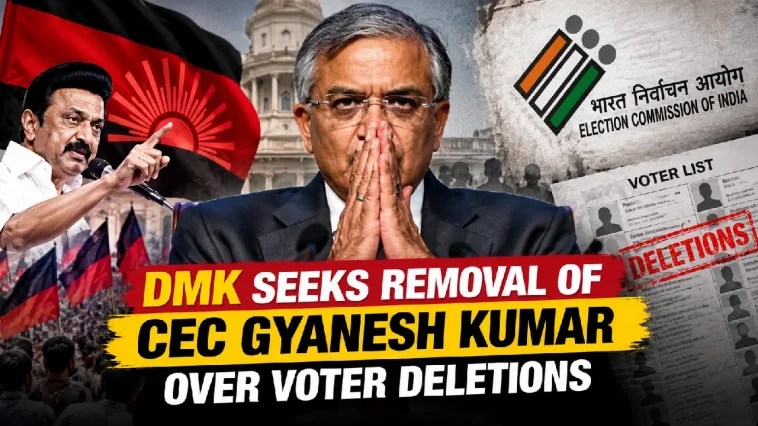
The DMK’s parliamentary group on Saturday demanded the removal of Chief Election Commissioner Gyanesh Kumar, the cancellation of the Special Intensive Revision (SIR) of electoral rolls, and the restoration of ballot-paper voting in place of electronic voting machines, at a meeting chaired by party president M.K. Stalin in Chennai.
The demands formed part of four resolutions adopted at the Murasoli Maran Meeting Hall in Anna Arivalayam, the party’s headquarters, where the meeting began at 11 a.m. on October 17. The parliamentary group also resolved to submit a petition to the President of India seeking corrective measures against alleged electoral irregularities. The resolutions did not specify individual instances of alleged irregularities or the grounds on which the party would seek the CEC’s removal, IANS reported.

The four resolutions
In its first resolution, the meeting called for Gyanesh Kumar’s removal from office, placing the Chief Election Commissioner at the centre of the party’s criticism of the electoral administration. A second resolution extended the DMK’s support to protests organised by student organisations, though it did not name the organisations involved, their specific demands, or the locations of the demonstrations.
The third resolution condemned the Congress and the Tamilaga Vettri Kazhagam (TVK), accusing both parties of adopting double standards, without elaborating on what prompted the criticism. The fourth resolution sought the complete cancellation of the SIR, the replacement of EVMs with ballot papers, and the submission of the petition to the President.
Allegations over the voter-roll revision
The DMK has alleged that Kumar oversaw the deletion of voters’ names during the SIR despite objections from the other two Election Commissioners, a claim reported by News18. These allegations are the party’s claims and should be distinguished from findings established through an independent inquiry.
On October 12, the Kerala Assembly passed a resolution seeking the CEC’s removal, described by Chief Minister V.D. Satheesan as a first in the history of the Kerala legislature. The resolution, moved by Satheesan, was backed by the CPI(M)-led Left Democratic Front, while the BJP’s three MLAs opposed it. It raised concerns over the SIR process, the exclusion of eligible voters, and the impartiality of the Election Commission, and demanded corrective action to ensure no eligible citizen is denied the right to vote. It also called for initiating removal proceedings against the CEC and reforming the committee that selects election commissioners, proposing a panel of the Prime Minister, the Leader of the Opposition in the Lok Sabha, and the Chief Justice of India to strengthen the Commission’s independence.
Supreme Court steps in
On October 15, the Supreme Court issued notices to the Election Commission of India and to Gyanesh Kumar on a petition filed by Lok Sabha Leader of Opposition Rahul Gandhi and other INDIA bloc leaders, challenging alleged large-scale voter deletions and irregularities in the ongoing SIR of electoral rolls. The bench of Chief Justice Surya Kant and Justice Joymalya Bagchi sought responses from the poll panel and its chief, and tagged the petition with other pending matters challenging the SIR in various states.
The petitioners include Congress president Mallikarjun Kharge, Samajwadi Party president Akhilesh Yadav, RJD leader Tejashwi Yadav, Trinamool Congress leader Saugata Roy, Shiv Sena (UBT) leader Sanjay Raut, and NCP (Sharadchandra Pawar faction) leader Supriya Sule, among other opposition figures. The bench clarified that issuing notice should not be read as a condemnation of any party, and said one petitioner would be asked to explain his conduct at the next hearing.
Earlier, on October 5, a Supreme Court bench had issued notices to the Election Commission and the Centre on a petition alleging that certain decisions were taken by the Commission, led by Gyanesh Kumar, without the approval of the two Election Commissioners. Senior Advocate Vikas Singh appeared for the petitioner, and the bench observed that Commission decisions should be taken either unanimously or by a majority, the standard procedure for such decisions.
What removal of a CEC actually requires
Under the Constitution, a Chief Election Commissioner can be removed only through a parliamentary motion alleging proved misbehaviour or incapacity, following the same procedure used for a Supreme Court judge. The motion requires the signatures of at least 100 members in the Lok Sabha or 50 in the Rajya Sabha; if admitted, a three-member inquiry committee comprising a Supreme Court judge, a High Court Chief Justice, and a distinguished jurist investigates the charges, with the CEC getting a full chance to defend himself. No Chief Election Commissioner has ever been removed in India.
Frequently Asked Questions
Who is the current Chief Election Commissioner of India?
Gyanesh Kumar is the incumbent Chief Election Commissioner of India. He has been at the centre of a political storm since the Election Commission began the Special Intensive Revision of electoral rolls, which opposition parties allege has wrongly deleted the names of eligible voters.
What is the Special Intensive Revision (SIR)?
The SIR is the Election Commission of India’s exercise to revise electoral rolls across states. The opposition, including the DMK, the Congress and the INDIA bloc, alleges that the revision has wrongly deleted the names of eligible voters’ names and a lack of transparency. These allegations have not been established by any independent inquiry, and the Supreme Court is examining petitions on the issue.
What exactly did the DMK demand on October 17?
At a meeting of its MPs chaired by M.K. Stalin in Chennai, the DMK adopted four resolutions: the removal of CEC Gyanesh Kumar, support for student organisations’ protests, condemnation of the Congress and the TVK for alleged double standards, and a petition to the President seeking the cancellation of the SIR and the replacement of EVMs with ballot papers.
Can a Chief Election Commissioner actually be removed?
Yes, but only through a parliamentary motion alleging proved misbehaviour or incapacity, signed by at least 100 Lok Sabha or 50 Rajya Sabha members, followed by an inquiry by a three-member committee and a presidential order. The bar is extremely high, and no CEC has ever been removed in India’s history.