

 Mohit Singh
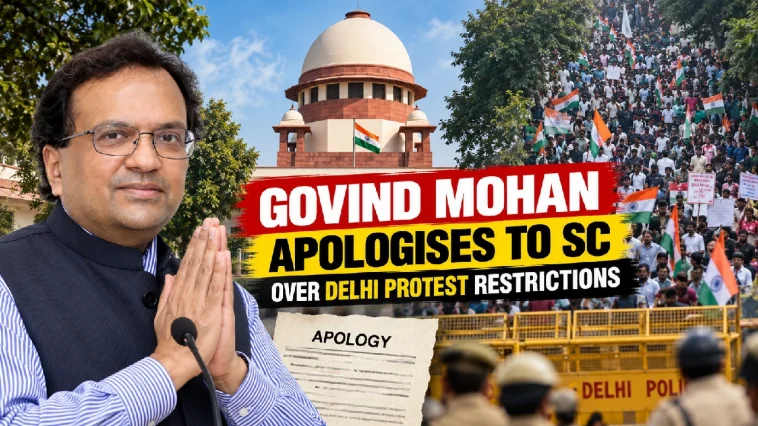
Union Home Secretary Govind Mohan has tendered an unconditional apology to the Supreme Court in contempt proceedings arising from the restrictions imposed in Delhi during the October 10 protests, while defending the one-day suspension of mobile internet services as a “proportionate measure”.
In an affidavit filed before the court, Mohan sought discharge of the contempt notice issued against him and asked the court to modify its October 11 order so that temporary internet suspensions remain possible in situations of necessity, in accordance with the law and applicable safeguards, LiveLaw reported.

The internet suspension at the centre of the case
According to the affidavit, cellular internet services were suspended from 10 pm on October 9 until 10 pm on October 10 within a four-kilometre radius of Raisina Hill in New Delhi. The Home Secretary said the restriction was limited to mobile internet — Wi-Fi, broadband and other non-cellular services were not covered by the suspension.
Mohan informed the court that Delhi Police had sought a one-day suspension of cellular internet services until 10 pm on October 10, and that the proposal was examined in accordance with the law and considered proportionate given the circumstances and the need to prevent disturbances in the national capital.
The affidavit stated there was no wilful or deliberate non-compliance with any court directions, and maintained that a temporary suspension of internet services, limited by duration and geographical coverage and subject to statutory safeguards, is a recognised measure for maintaining public order in appropriate circumstances.
How the contempt case arose
The controversy began with a Supreme Court order on October 9, when a Bench of Chief Justice Surya Kant, Justice Joymalya Bagchi and Justice V. Mohana held that Metro and train services in Delhi could not be completely prohibited ahead of the October 10 protests seeking the resignation of Chief Election Commissioner Gyanesh Kumar over the Special Intensive Revision of electoral rolls, and directed that services run in a regulated manner, LawChakra reported.
Advocate Shailendra Mani Tripathi then filed a contempt petition alleging that authorities had gone ahead with Metro station closures, train restrictions and a mobile internet shutdown in breach of that order, along with complaints of mass detentions. The contempt plea named Mohan, Delhi Police Commissioner Anurag Kumar and Delhi Metro Rail Corporation Chairperson D Thara.
At a special Sunday sitting on October 11, Justices Bagchi and Mohana recorded a prima facie case, issued notice to the alleged contemnors, and passed interim directions that Metro and rail services function normally, people move freely, internet facilities remain undisturbed and no one be illegally detained, Bar and Bench reported.
Thursday’s hearing before the Chief Justice
The contempt petitions came up on October 15 before a Bench of Chief Justice Surya Kant and Justice Joymalya Bagchi, with Solicitor General Tushar Mehta appearing for the authorities. Mehta raised concerns about media reporting on the apologies at the outset, telling the court that the government had defended its actions even as it apologised.
Chief Justice Kant responded: “What the media does is not relevant. We are not holding proceedings for the media,” according to LawChakra. The Solicitor General submitted that an unconditional apology at the head of a contempt affidavit is settled practice and not an admission of wilful disobedience, adding that the affidavits then explain why no contempt was committed.
Directions on evidence and journalists’ devices
During the same hearing, the Supreme Court directed all law enforcement agencies to preserve CCTV footage and any other digital material collected by them during the protests, noting that such footage is typically overwritten within 30 to 60 days. Private parties were also given the liberty to preserve material collected by them, LawChakra reported.
The court also issued notice on a plea by the Delhi Union of Journalists seeking the return of journalists’ electronic devices allegedly seized by the police. The Solicitor General stated on instructions that no devices had been seized, and the court recorded that statement while issuing notice.
Separately, the Bench issued notice on challenges to Section 172 of the Bharatiya Nagarik Suraksha Sanhita, which permits the police to detain or remove persons who disregard their directions — a provision critics say enabled arbitrary detentions at the protest.
What happens next
As LawChakra noted, the allegations in these petitions and the authorities’ responses remain untested, and the court has expressed no view on the merits. Whether the apology is accepted and the contempt notice discharged — and whether the October 11 direction on internet access is modified — will be decided as the matter proceeds.
FAQs
Who is Govind Mohan?
Govind Mohan is the Union Home Secretary of India, the senior-most official of the Ministry of Home Affairs. He filed the affidavit responding to the Supreme Court’s contempt notice in the case concerning the October 10 Delhi protest restrictions.
Why did Govind Mohan apologise to the Supreme Court?
Mohan tendered an unconditional apology in response to a contempt notice issued after a petition alleged that the suspension of mobile internet and restrictions on Metro services during the October 10 Delhi protests violated the Supreme Court’s October 9 directions. He also asked for the notice to be discharged, maintaining there was no wilful disobedience.
How long was the mobile internet suspended in Delhi?
Cellular internet services were suspended from 10 pm on October 9 until 10 pm on October 10 — a 24-hour period — within a four-kilometre radius of Raisina Hill in New Delhi. Only cellular internet was affected; Wi-Fi and broadband remained functional.
What did the Supreme Court decide on October 15?
On October 15, a Bench of Chief Justice Surya Kant and Justice Joymalya Bagchi heard the contempt petitions, directed law enforcement agencies to preserve CCTV and digital material from the protests, and issued notice on pleas concerning journalists’ devices and Section 172 of the Bharatiya Nagarik Suraksha Sanhita. The court has expressed no view yet on the merits of the contempt case.